


After 11 years of divorce, a customary Court holden at Rumuogba in Rivers State, has stripped Mrs Kate Ngbor of continuing bearing her former husband’s names with immediate effect.
The Claimant, Chief Sam Ngbor, has in suit no: OCC/9/2021, sought the court order to restrain his former wife, Mrs Kate Ngbor from continuing bearing his name.
The court, after the submissions from E. O Erhirhi Esq, counsel of the claimant and R.U Egwenre Esq, counsel for the defendant granted the orders.
The court ordered that the defendant has no right, except on the express permission of the claimant, to continue to bear or answer the name “Ngbor” or “Sam-Ngbor” (as the case may be).
The court consequently in the judgement stripped the defendant of the name “Ngbor” or “Sam-Ngbor”.

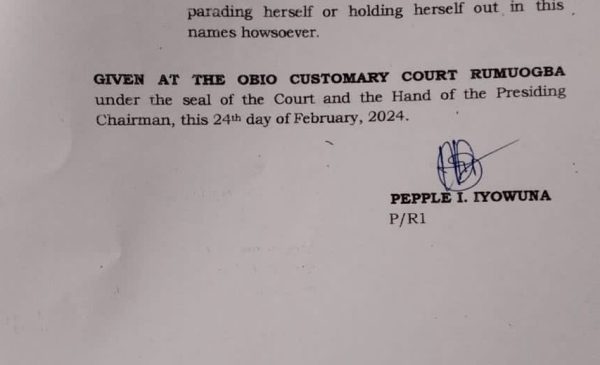
“The court ordered the defendant to revert to her maiden name or any other name of her choice, excepting “Ngbor” or “Sam-Ngbor” as the case may be.
The court restrained the defendant from further bearing the name Mrs. Kate Ngbor or Mrs. Kate Sam-Ngbor (as the case may be) or further parading herself or holding herself out in this names howsoever”.



This case is already in appeal. Mrs Kate Sam-Ngbor and her lawyer have sent notice of appeal to Mr. Samuel Ngbor her husband and the customary court where the judgement was delivered within 5 days after the rulling, which is accordance with the law. So the husband oaught had publish the court judgement.
If a court delivers a judgment and then receives a notice of appeal, it’s generally considered appropriate for the court and the claimant or defendant, as the case may be to refrain from taking further action, including publishing the judgment in the media, until the appeal process has been resolved.
Here’s why:
1. *Presumption of innocence*: Until the appeal is decided, the judgment is not considered final. Publishing the judgment could be seen as premature and potentially damaging to the appellant’s reputation.
2. *Sub judice rule*: The sub judice rule prohibits public discussion of a case that is still pending, including appeals. Publishing the judgment could be seen as violating this rule.
3. *Respect for the appeal process*: Allowing the appeal process to unfold without external influence or publicity helps maintain the integrity of the judicial process.
This story is unprofessionally and unethically written or done as it is one sided already. Where real professional journalism is practice. This editor or reporter would have sought to hear from the wife and balance the story before publishing it. He too cdn be help of contampt of court. I have been a journalist for 39 years now and trust me I know what i am talking about.